Blog
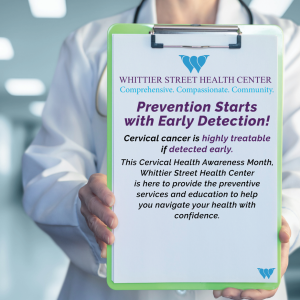
Cervical Health Awareness Month

Cervical cancer is the fourth most common cancer found in women globally, with about 13,000 new cases diagnosed every year in the United States1. While these numbers are concerning, cervical cancer is also one of the most preventable and treatable cancers when detected early. Over the past three decades, the American Cancer Society has documented a 50% reduction in cervical cancer rates and mortality, largely due to expanded access to cervical cancer screening (Pap test) HPV (human papillomavirus) screening, and the HPV vaccine2.
Timely access to preventive care is critical to preventing cervical cancer or detecting it at its most curable stages. Standard medical guidelines recommend:
- Two doses of the HPV vaccination for adolescents and young adults between the ages of 11 and 12, which can significantly the risk of HPV-related cancers pre-viral exposure.
- Pap tests every three years for women between the ages of 21 and 29.
- HPV testing, either alone or combined with a Pap test, starting at age 30.
Despite these advances, not all women have equitable access to cervical cancer screening and vaccination. Social determinants of health, including lack of insurance coverage, limited access to sexual health education, language barriers, and gaps in preventive care, remain among the biggest obstacles to care for women from historically marginalized communities. Research shows that Black and Hispanic women are more likely to be diagnosed with cervical cancer at later stages and are less likely to receive timely, provider-initiated screening and prevention counseling, contributing to worse health outcomes and mortality rates³.
Addressing these disparities requires intentional, community-based approaches that remove barriers to care and prioritize prevention for those most at risk. At Whittier Street Health Center, we are committed to advancing women’s health equity by offering on-site cervical cancer screening, HPV vaccination, and educational outreach. Our care teams, together with our partners from the Dana-Farber Community Cancer Institute, work diligently to ensure that our patients receive their recommended cancer screenings on time and offer navigation support services to any woman with an abnormal test result, ensuring guidance at every step of the way.
This Cervical Health Awareness Month, we encourage you to connect with your health care provider to ensure that you are up to date on recommended cervical cancer screenings and vaccination. Take the first step toward better health by connecting with our OB/GYN department at (617) 989-3129, or visit https://www.wshc.org/services/obgyn/.
References
- Centers for Disease Control. (2025, June 10). Cervical Cancer Statistics. Retrieved from https://www.cdc.gov/cervical-cancer/statistics/index.html.
- American Cancer Society (2024, February 21). Just the Facts: Cervical Cancer Disparities. Retrieved from https://www.fightcancer.org/policy-resources/just-facts-cervical-cancer-disparities.
- Healthy Americas. (2021, January 27). National survey finds lag in cervical cancer screening and information for Hispanic and Black women. Retrieved from https://www.healthyamericas.org/press-release-index-1/national-survey-finds-lag-in-cervical-cancer-screening-and-information-for-hispanic-and-black-women.